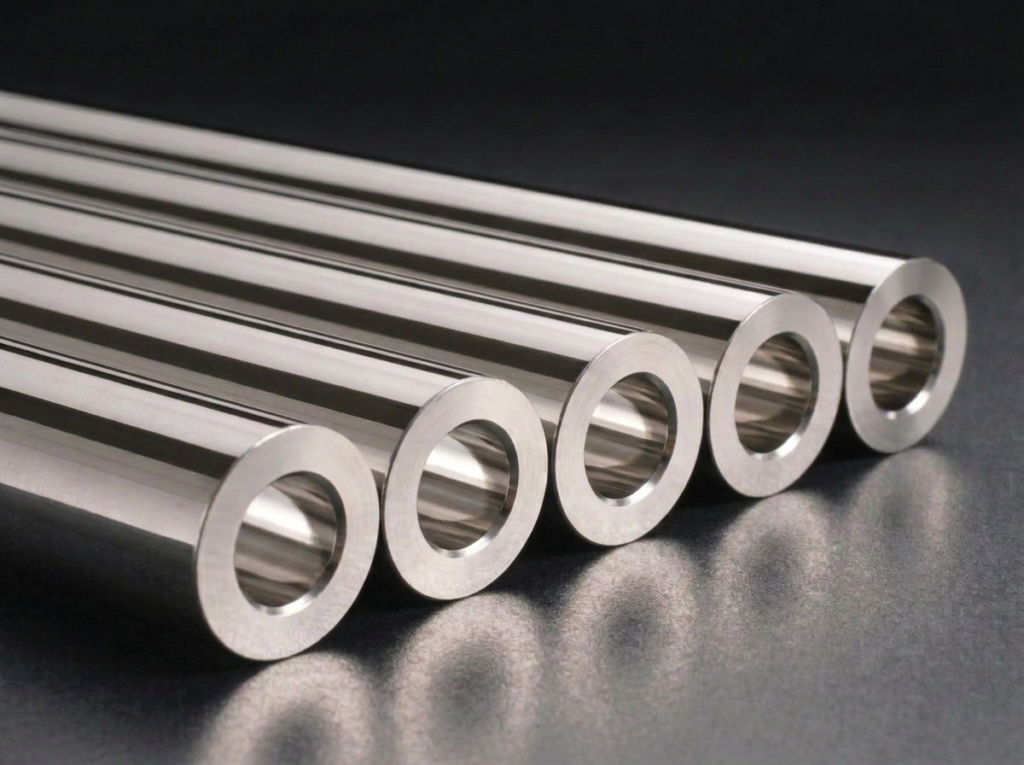
Chemically Polished Stainless Capillary Tubing
Ultra-fine capillary tubing, chemically polished where other processes can’t reach.
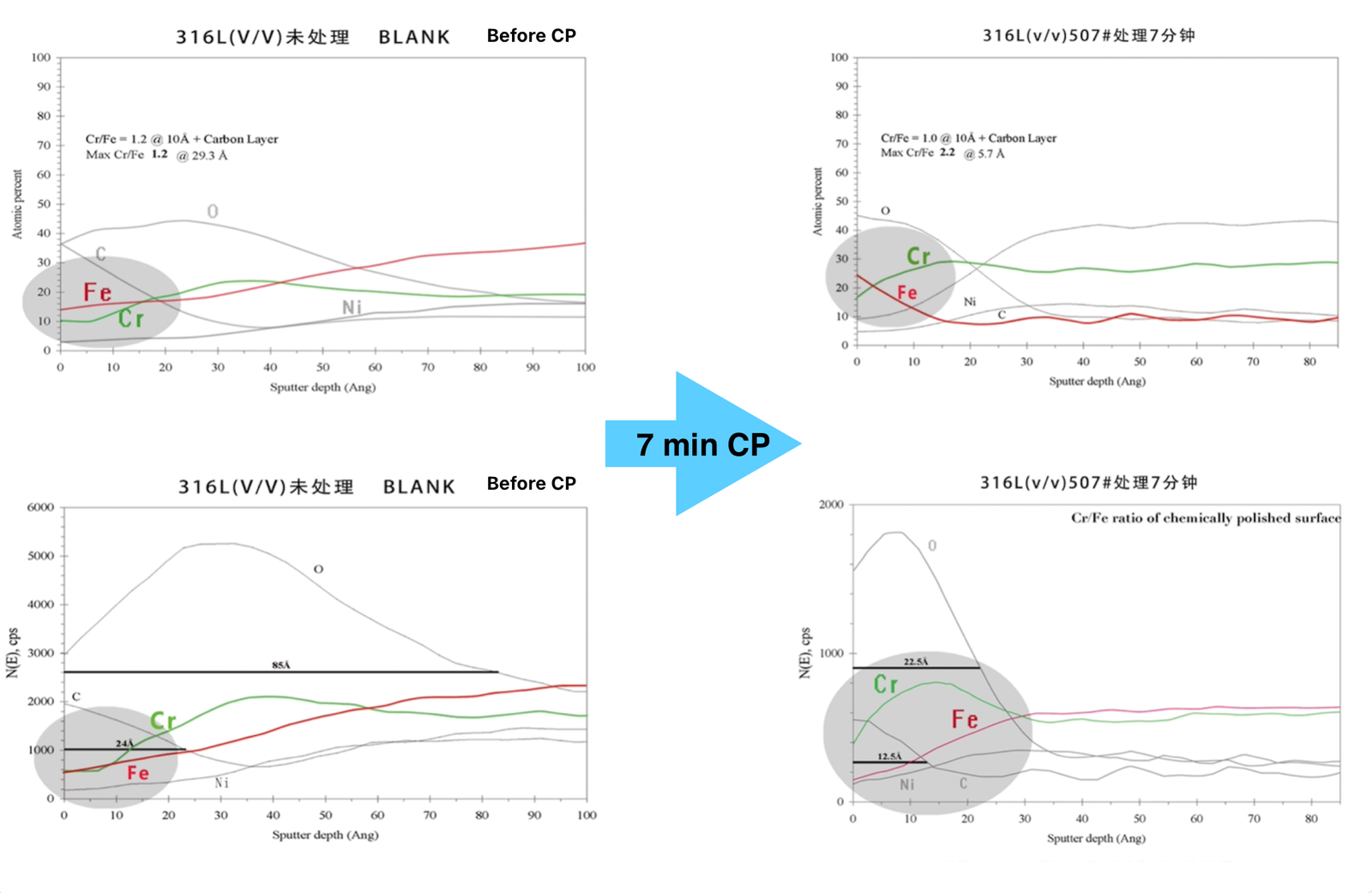
We supply chemically polished stainless steel capillary tubing — bore Ø0.2 to 1.0 mm(0.008″ – 0.039″) — for semiconductor and analytical instruments. Beyond smoothing, our process improves the surface chemistry itself: higher Cr/Fe ratio, a cleaner passive layer, better corrosion resistance. It also reaches geometries such as bellows, where abrasive tools and electrodes physically cannot go.
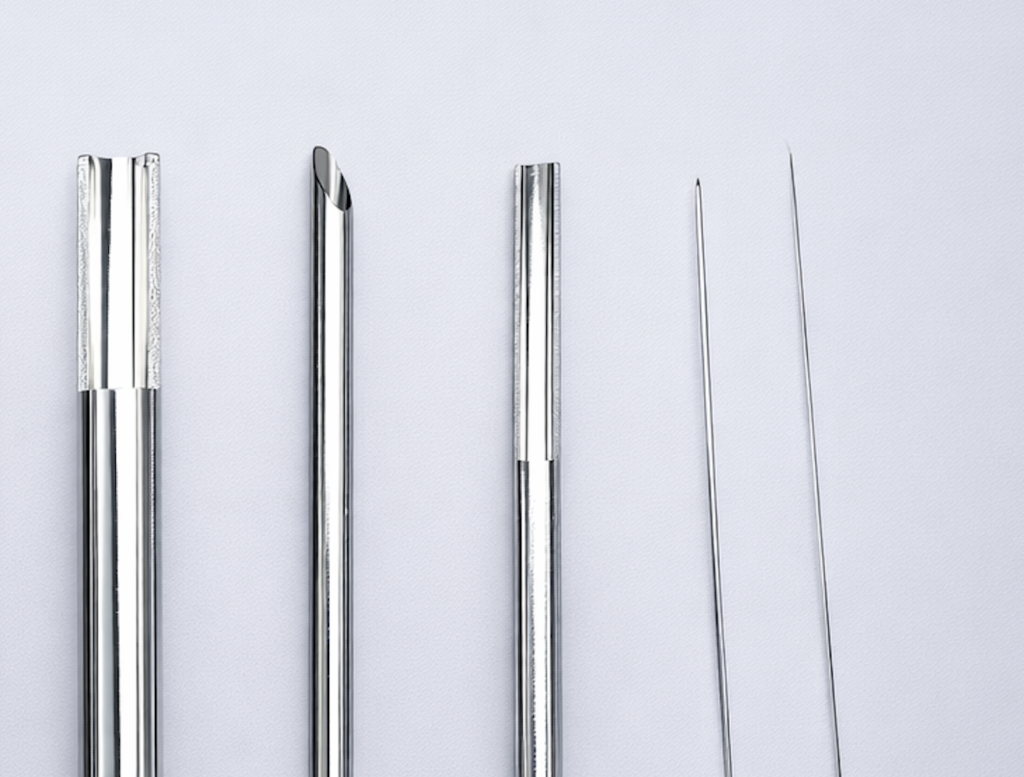
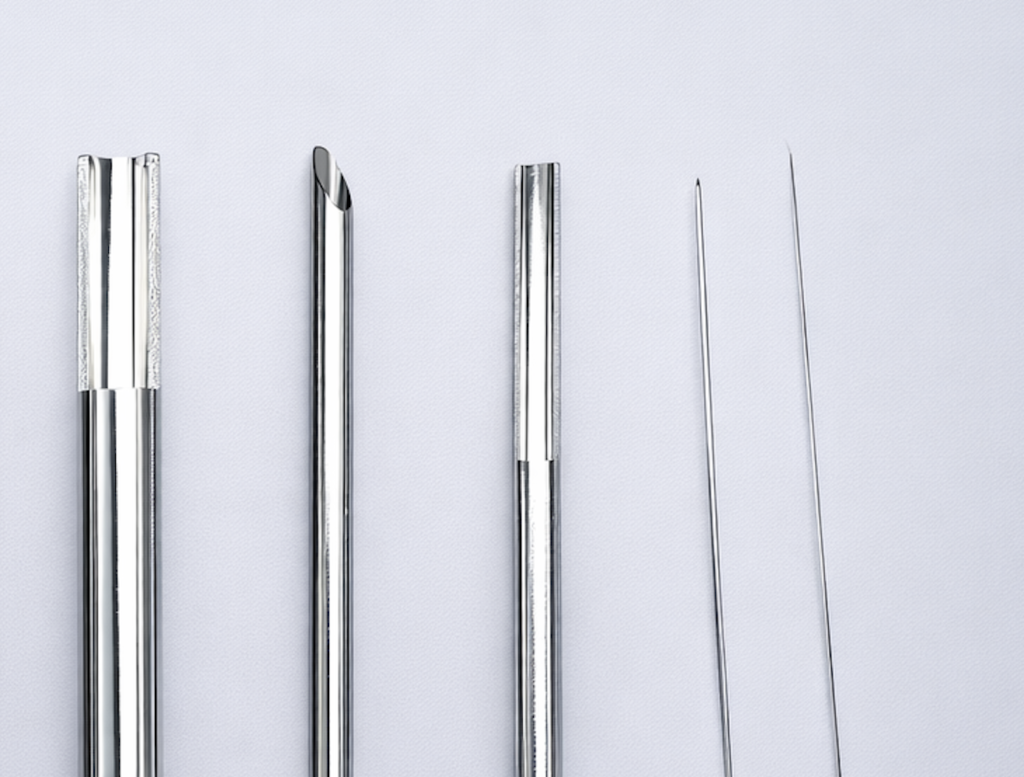
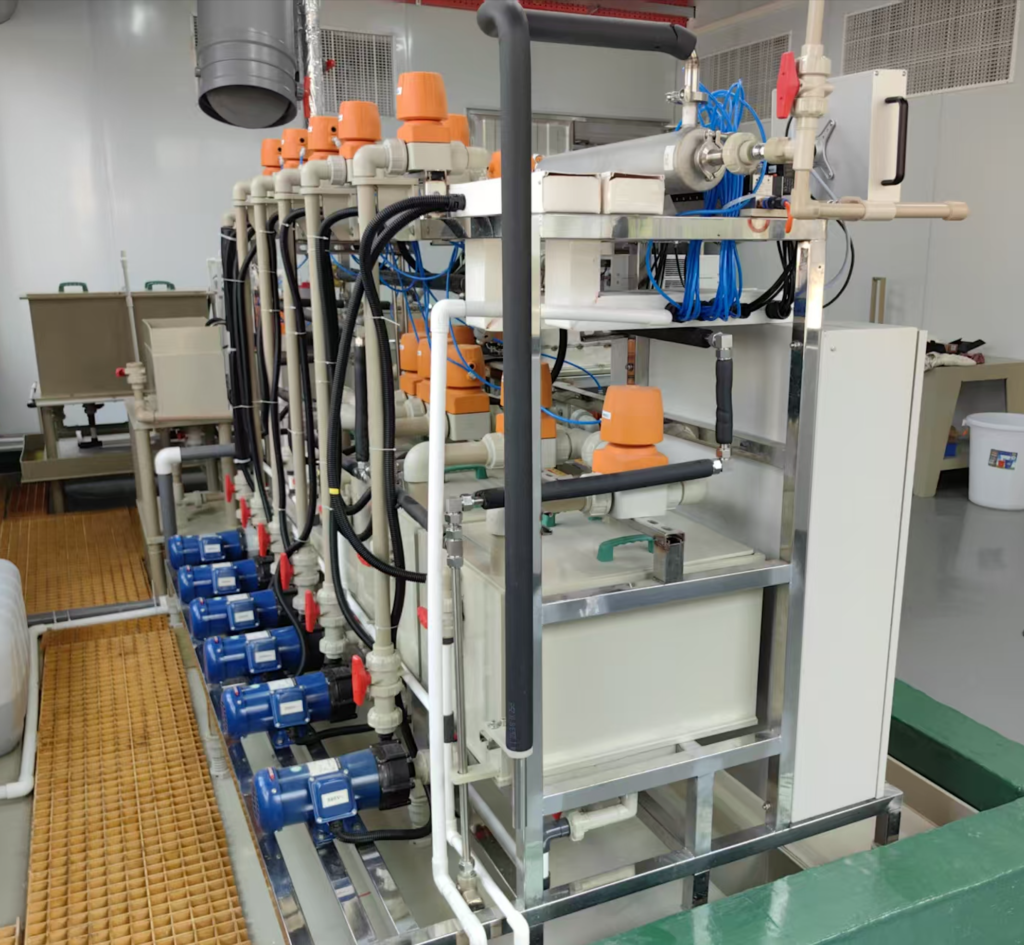
Chemical polishing can treat internal geometries that other methods can’t reach. Applying it uniformly inside an ultra-fine bore or a bellows, however, is a problem that conventional dip processing doesn’t solve. We developed dedicated equipment specifically for this task. Combined with polishing chemistry refined through a long-standing partnership, it delivers consistent, repeatable results in volume production — down to Ø0.2 mm.
Smoothness alone doesn’t define internal quality.
Surface roughness can be reduced by mechanical polishing as well — magnetic abrasive finishing reaches around Ra 0.1 µm even on fine bores. What actually determines part life and cleanliness in flow meters, sensors, and semiconductor gas and liquid lines is the chemical state of the surface. Our chemical polishing smooths the bore and, at the same time, delivers three things a mechanical process fundamentally cannot:
Higher Cr/Fe Ratio, Better Corrosion Resistance
Enriches surface chromium and promotes a stable Cr-rich passive layer — an effect mechanical polishing cannot produce, since it never alters the surface chemistry. (Third-party verified; results depend on base material.)
Stress & Contamination Removal
Dissolves the work-hardened layer and residual stress left by machining, and removes embedded particles and oils that cleaning alone cannot reach — leaving a chemically clean surface.
Burr-Free, Smooth Bore
Dissolves burrs preferentially from the root, leaving no secondary burrs. The bore finishes to a smooth mirror surface, with reduced flow resistance and particle generation (Ra 0.17 µm/ 6.7 µin measured).
Process Comparison
How mechanical polishing (MP), electropolishing (EP), and chemical polishing (CP) differ in scope.
| Criteria | Mechanical (MP) | Electropolishing (EP) | Chemical (CP) |
|---|---|---|---|
| Ø0.2 mm(0.008″) bore | ○ | ✕ Electrode can’t enter | ◎ Treatable |
| Bellows internal surface | ○ | ✕ Electrode can’t enter | ◎ CP only |
| Cr/Fe ratio (corrosion resistance) | ✕ No chemical change | △ | ◎ Improved (material-dependent) |
| Residual stress / worked layer | ✕ Created by process | △ | ◎ Removed |
| Embedded contamination | ✕ Embedded by process | △ | ◎ Dissolved |
| Volume production | △ | ✕ Individual electrodes required | ◎ Dedicated equipment |
Find what you’re looking for
Choose the page that matches your needs.
Looking for UHP capillary tubing
Precision stainless capillary, Ø0.2–1.0 mm (0.008″–0.039″) bore, internally chemical-polished. Supplied as finished tubing for high-purity semiconductor and analytical applications.
Need internal surfaces polished
Toll processing of customer-supplied parts — including bellows and other geometries that mechanical and electropolishing can’t handle.
Considering a technology partnership
Technology transfer and joint production for long UHP tubing. Equipment supply and technical guidance available.
Why we can treat ultra-fine and complex internal surfaces
Our chemical polishing builds on more than 20 years of production experience, dating back to 2005. For ultra-fine bores and complex geometries, we developed dedicated processing equipment, and control quality through an integrated 11-step process. Surface chemistry is verified by third-party laboratories — RJ Lee Group (USA), per SEMI standards.